FLOW CONTROLS
Flow Controls provide a simple way to manually change how incoming calls are routed. Each Flow Control has two paths: Normal and Override. The Normal path follows your regular call flow. When you switch the Flow Control to Override, incoming calls are automatically redirected to the alternate destination you've configured.
Unlike automated Time Controls, which follow a set schedule, Flow Controls let you change your call routing whenever you need to. This can be useful for unexpected office closures, staff training days, special events, or temporarily accepting calls outside of your regular business hours.
System administrators are able to manage existing flow controls, as well as create new ones, in the Account Center. Locate Flow Controls in the Phone System menu and expand the heading. Here you will see options to both Manage and Create flow controls.
BEFORE YOU BEGIN
Before creating a Flow Control, it helps to think about how you want calls to be handled both when the Flow Control is set to Normal and when it is switched to Override.
Before you select these destinations, make sure everything you plan to use in each path has already been created.
- For example, if your Normal path will send calls to a Time Control, the Time Control and its associated Calendar should already be set up.
- If your Override path will send calls to an Emergency Ring Group, that Ring Group should also be created before you begin.
- You can also assign a System Recording for callers to hear before they are sent to either destination. You can use the default recording or create a custom recording. Any custom recordings must be created in the System Recordings section of the Account Center before you set up your Flow Control.
CREATE FLOW CONTROLS
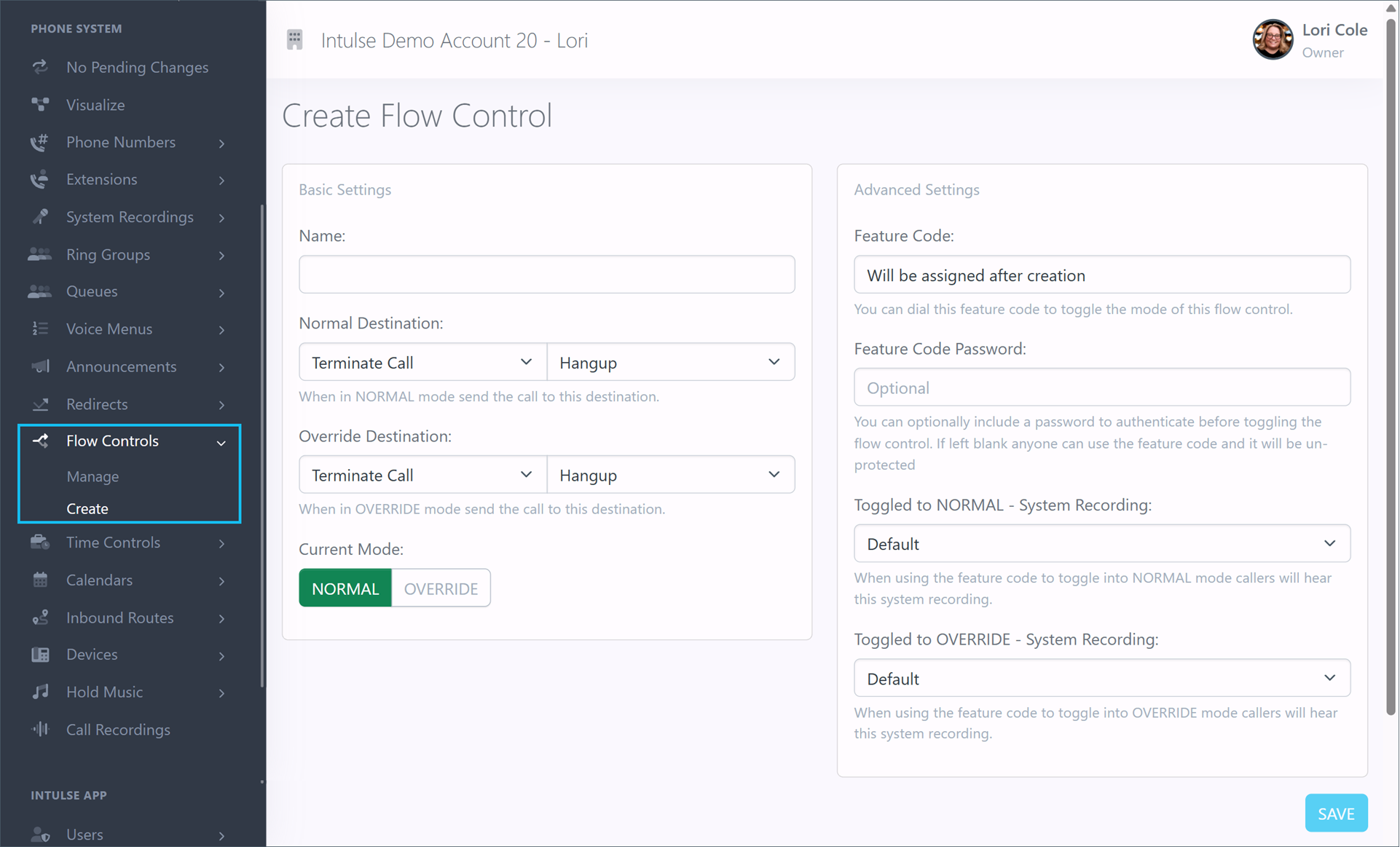
The Create Flow Controls page is where you can set up a new flow control on your account, allowing you to override any time control settings.
BASIC SETTINGS
To set up a new flow control, follow these steps:
- Give your flow control a Name that will make it easy to identify.
- Select the Normal Destination for the call. This is where you want your call to go under Normal circumstances, possibly to a time control determining your open and closed hours, a Voice Menu, Ring Group, or another destination in your call flow. (Make sure whatever option you select here is set up and ready to function as part of your call flow.)
- Select the Override Destination for the call. This is where you want your call to go when you toggle your flow into override mode, causing it to ignore the normal settings. (Make sure whatever option you select here is set up and ready to function as part of your call flow.)
- For example, if your office unexpectedly closes during business hours, your Override Destination might be an announcement telling callers about the closure, followed by voicemail or a Closed Voice Menu.
- If you're using a Flow Control to open your phones after hours, your Override Destination could instead send calls directly to an extension or group of people who are available to answer them.
- Decide if you want to leave it in Normal mode, or switch it to Override mode when it's first activated.
- In most cases, you'll want to leave this set to Normal so your regular call flow is active. You can then switch to Override whenever you need to temporarily change how calls are handled.
ADVANCED SETTINGS
There are a few more optional settings for you here.
- A Feature Code will be assigned to this flow control once you click Save. This code can be dialed from your Intulse enabled phone or Intulse app to toggle your flow control between normal and override modes.
- Decide if you would like to enter a Feature Code Password to limit access to this flow control. Only people with this password will be able to toggle between modes.
- Select System Recordings for both the normal and override modes if you want callers to hear a recording before going to the selected destinations. A default message is already selected for each path, but you can record your own custom message instead if you choose. (These will need to be recorded in the System Recordings portion of the Account Center before they can be attached here.)
- When you click Save, your flow control will be added to the list of flow controls that currently exist on your account. You can select it here, or use the assigned feature code to toggle between modes.
IMPLEMENTING FLOW CONTROLS
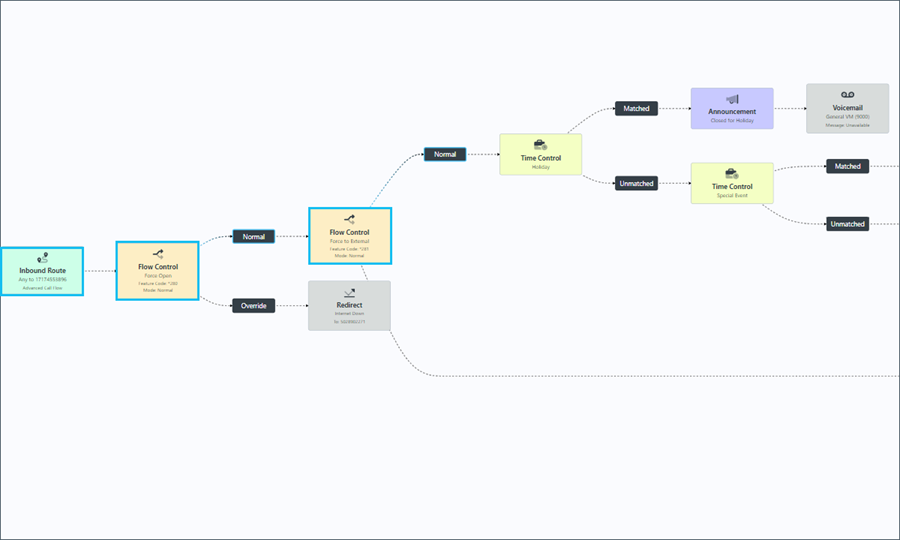
Creating the Flow Control is only the first step. Before it can affect incoming calls, it needs to be added to your active call flow. Flow controls are added to your call flow when selected within other system features. As you configure your call flow, use the Visualize screen to follow the arrows and verify that each part of the call flow is connected correctly, and that calls are being routed as intended.
For example, in the call flow shown below, the first flow control is selected as an option within the inbound route, and the second is selected as an option within the first flow control.
The first flow control is added by going to Inbound Routes in the Account Center or by selecting a specific inbound route on the Visualize screen. From the settings screen, you can select the flow control you would like to attach.
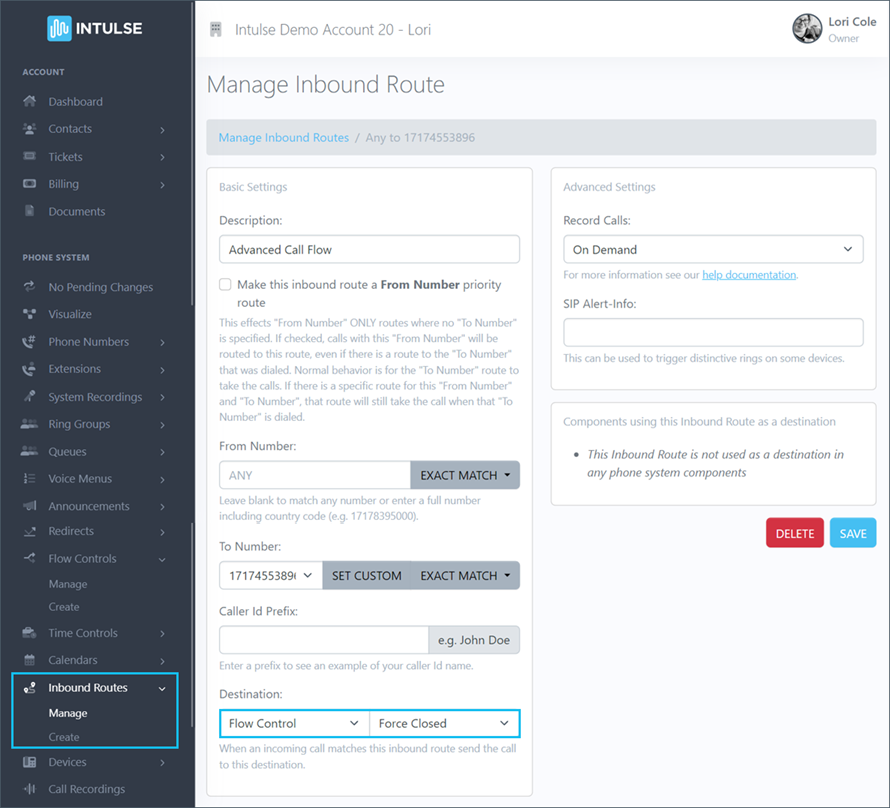
This is the most common use of flow controls, but they can also be used with any other system feature.
Some changes related to your phone system's behavior, such as adding or editing flow controls, are not live immediately. Rather, the changes are "queued" and waiting to be applied. This allows you to make ALL of the necessary changes and verify that all pieces of the call flow are in place and functioning together as expected before making them live. Once you've tested your changes and are confident your system is functioning correctly, select "Apply Changes" on the left-hand menu to make your system live. A confirmation popup will open asking if you're certain you wish to apply your changes.
USING FLOW CONTROLS
Once a new Flow Control is active, there are a few ways to toggle between the Normal and Override paths.
- System administrators can return to the Flow Control in the Account Center at any time and change the Current Mode setting.
- Authorized users can also change the mode by dialing the Feature Code, preceded by an asterisk, from an Intulse managed desk phone or the Intulse app. If a password was set, it will be required here. Dialing the Feature Code immediately toggles the Flow Control between Normal and Override modes.
- Flow Controls can also be managed using a BLF button on your physical device. The button will glow green in Normal mode and red in Override.
- Flow Controls can be added to Smart Monitoring in the Intulse app, where they can easily be toggled on/off. By default, only system administrators can monitor Call Flow Controls, but additional security roles or individual users can be authorized to access them in the Admin portion of the app.
Remember, when you switch a Flow Control to Override mode, the Override path will remain active until you switch it back to Normal mode.
